



From 22 to 24 June 2026, U2Demo partners participated in the European Energy Market (EEM) Conference 2026 in Trondheim, Norway. The conference brought together researchers, industry experts and policymakers from across Europe to exchange knowledge on electricity markets, energy communities, flexibility and the integration of renewable energy resources.
Representatives from VITO, EIFER and KU Leuven presented research addressing key challenges in the energy transition, ranging from local energy trading and energy community design to artificial intelligence applications and electricity market mechanisms.
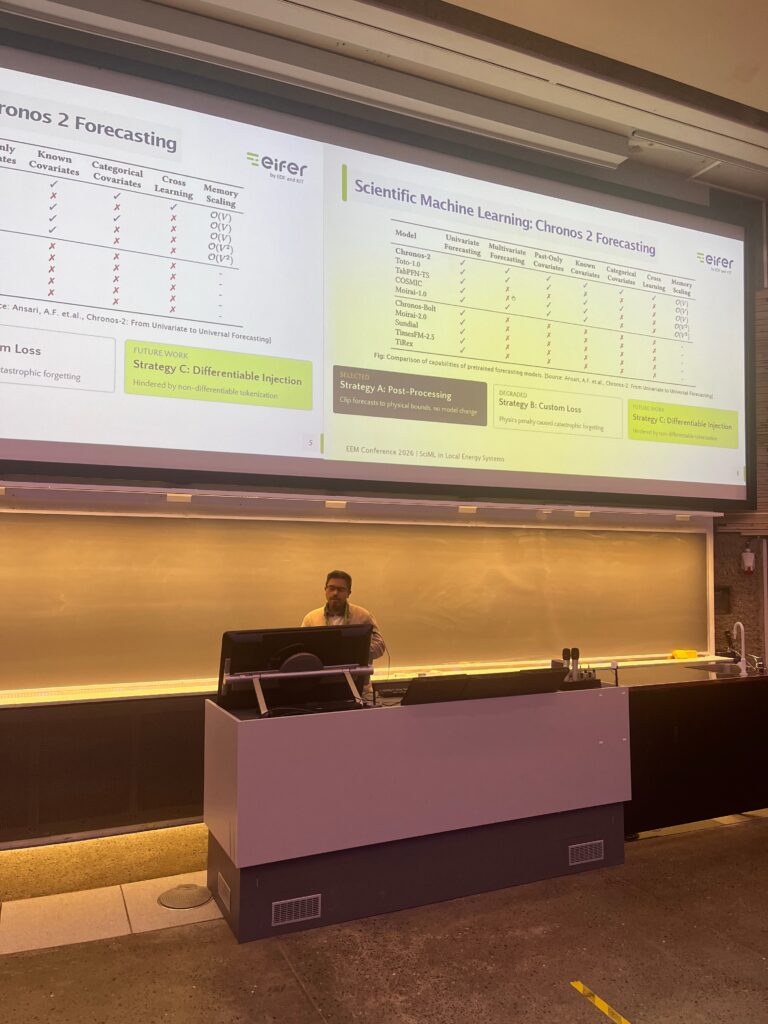
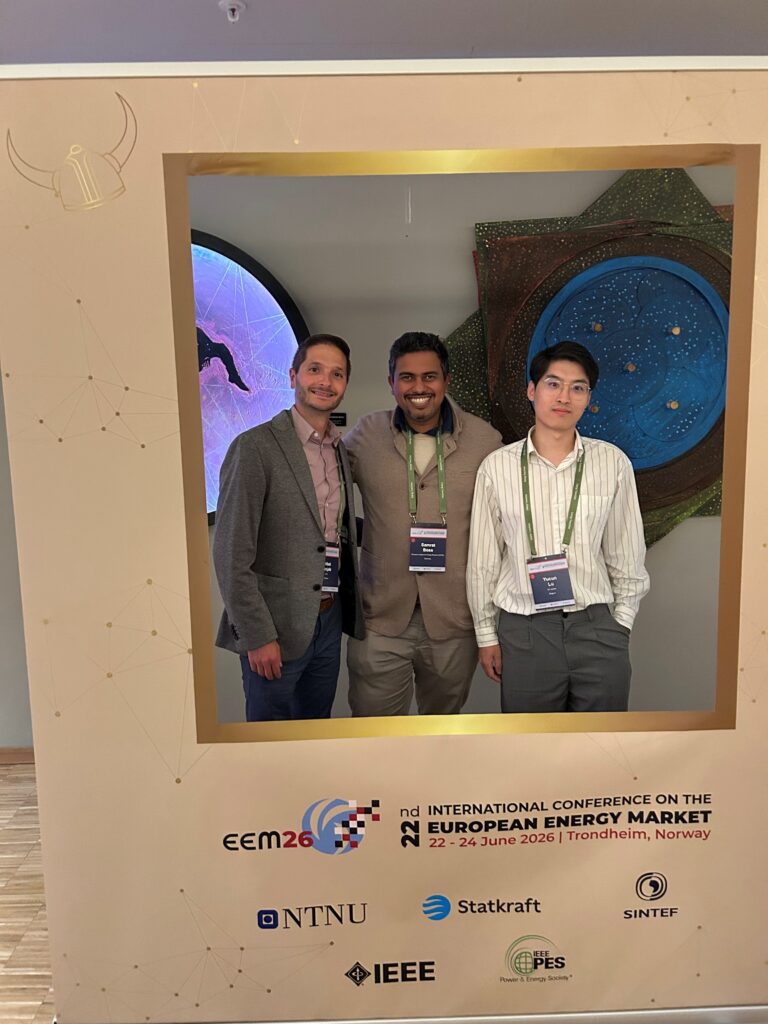
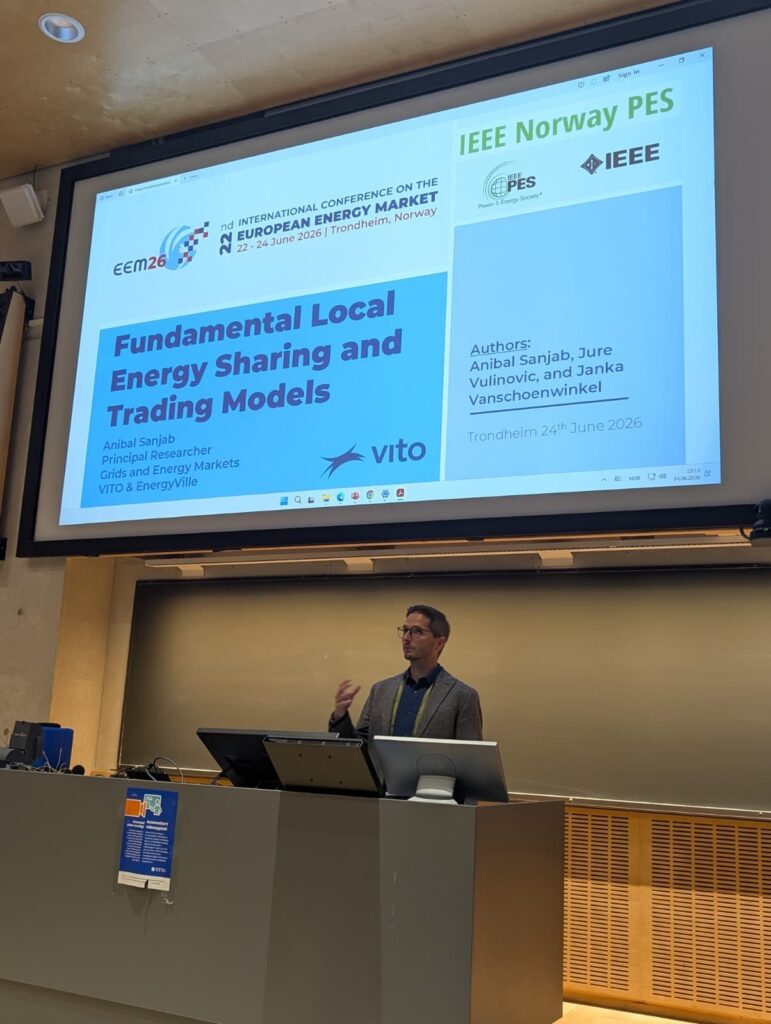
Left Samrat Bose. From left to right Anibal Sanjab, Samrat Bose, and Yucun Lu. Right Anibal Sanjab.
Designing local energy sharing and trading models
Anibal Sanjab (VITO) presented the paper “Fundamental Local Energy Sharing and Trading Models“, which contributes directly to the objectives of the U2Demo project by addressing one of the key building blocks of energy communities: the design of local energy sharing and trading schemes.
The paper introduces a unified classification framework for local energy sharing and trading, identifying six fundamental models that capture the approaches currently used in practice, pilot projects and academic research. Using a decision-tree approach, the framework distinguishes between collective asset sharing models, where community members jointly invest in and benefit from shared assets such as solar PV installations or community batteries, and individual asset-based sharing models, where participants exchange energy based on their own generation, storage or flexible demand assets.
The research further categorizes individual energy-sharing approaches into centralized and peer-to-peer market designs, providing a comprehensive overview of how local energy transactions can be organized within energy communities.
As a result, the paper provides valuable guidance for policymakers, researchers and practitioners working to scale energy communities across Europe by systematically mapping real-world initiatives and assessing the strengths and challenges of each model. The findings directly support U2Demo’s ambition to develop innovative and practical local energy market solutions for citizen-led energy communities.
Scientific Machine Learning for Local Energy Systems
Samrat Bose (EIFER) presented the paper “Scientific Machine Learning for Local Energy Systems“, which was selected for an oral presentation at EEM 2026. The research explores how scientific computing and data-driven machine learning can be combined to improve the operation and control of local energy systems.
Using the Dutch U2Demo pilot site as a real-world energy community, the study demonstrates one of the first multi-model Scientific Machine Learning approaches for local energy systems. The framework also integrates stakeholder simulation through Agent-Based Modelling, power flow analysis, transformer-based forecasting using Chronos 2, and Model Predictive Control (MPC) for energy management.
The results show that combining machine learning with physics-based optimization can outperform purely data-driven approaches. The proposed methodology achieved a reduction in peak load and equivalent battery cycling, while delivering more robust system performance. These findings demonstrate the potential of Scientific Machine Learning to support the operation of future local energy communities and facilitate the integration of distributed renewable energy resources.
Interested in the technical details? Browse the presentation to learn more about the Scientific Machine Learning approach demonstrated on the Dutch U2Demo pilot site and its impact on local energy system management.
Understanding electricity market incentives
Yucun Lu (KU Leuven) presented the paper “The Impact of Retail Contract Design on Wholesale Procurement Strategies”, examining how different electricity retail contract designs influence the procurement decisions of electricity retailers.
Using a three-stage stochastic optimization model, the research analyses how retailers balance long-term hedging and day-ahead market purchases under different pricing structures. The study shows that retail contracts indexed to day-ahead electricity prices significantly reduce the need for forward purchases because they shift part of the price risk from retailers to consumers.
Additionally the results show that moving from hourly price indexation to monthly or annual fixed-price arrangements increases exposure to demand profile risk, leading retailers to procure more energy in forward markets and apply higher retail margins. The research provides valuable insights into how contract design can influence risk allocation, market behaviour and the efficiency of electricity procurement strategies.
These findings contribute to ongoing discussions on the design of future electricity markets and consumer participation in increasingly flexible and decentralized energy systems.
Strengthening U2Demo’s impact
The research presented at EEM 2026 reflects the breadth of expertise within the U2Demo consortium. From local energy sharing and trading models to Scientific Machine Learning and electricity market design, the contributions showcased innovative approaches to supporting more flexible, decentralized and consumer-centred energy systems.
Visit our Publications page to access all scientific papers, conference contributions and other project outputs.
Comments are closed.