



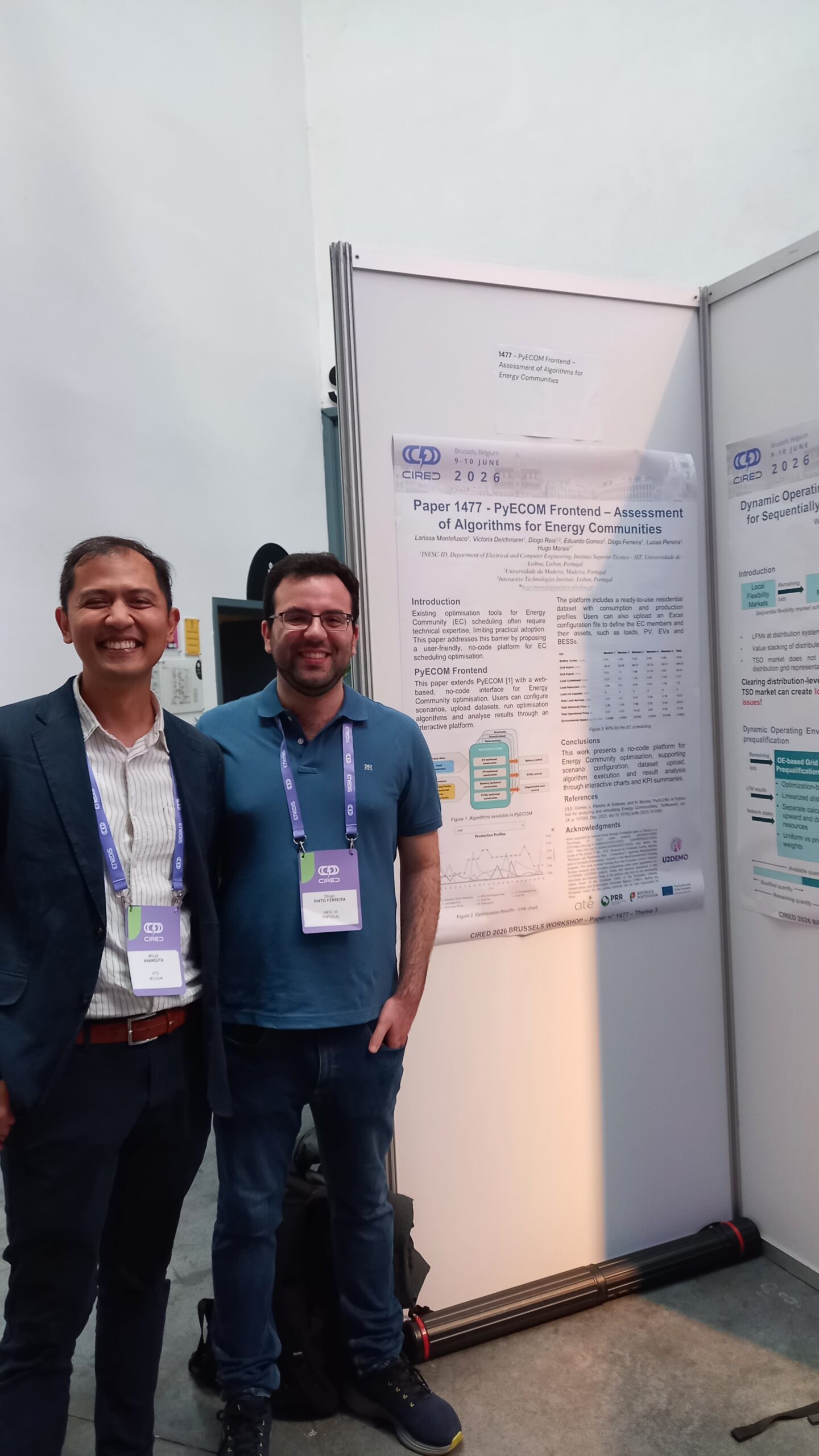
U2DEMO was represented at CIRED 2026, one of the leading international conferences on electricity distribution. During the event, Diogo Pinto Ferreira (INESC-ID) presented the poster “PyECOM Frontend – Assessment of Algorithms for Energy Communities” (Paper ID: 1477), highlighting an important step towards making energy community optimization tools more accessible to a wider range of users.
Bringing Energy Community Optimisation Closer to Users
As energy communities continue to grow across Europe, managing and optimising distributed energy resources becomes increasingly complex. Communities often need to coordinate solar generation, battery storage, flexible demand, and other assets to maximise benefits for their members.
To support these challenges, researchers developed PyECOM, an open-source framework that enables the analysis, simulation, and optimization of energy communities. Despite its capabilities, using such tools often requires programming expertise, creating a barrier for many practitioners and community stakeholders.
The work presented at CIRED 2026 builds on the broader U2DEMO effort to develop practical tools and methodologies for energy communities. The optimization functionalities showcased through the PyECOM frontend support several of the energy community use cases identified within the project’s Use Case Repository.
The poster presented at CIRED 2026 addressed this challenge through the development of a web-based, no-code frontend for PyECOM.
Making Advanced Tools More Accessible
The new interface enables users to interact with energy community optimisation algorithms without requiring programming knowledge.
Through the platform, users can:
- Configure optimisation scenarios
- Upload and analyse datasets
- Run energy community scheduling algorithms
- Explore results through interactive visualisations
- Review key performance indicators (KPIs)
By simplifying access to advanced optimisation tools, the frontend broadens the potential user base to include energy community managers, policymakers, local authorities, and other stakeholders involved in the energy transition.
Supporting Transparent Decision-Making
Beyond improving usability, the interface also helps foster transparency in energy community operations. Interactive dashboards and visual summaries allow users to better understand optimisation outcomes and compare different scenarios, supporting more informed decision-making.
Advanced optimisation algorithms only create real-world impact when people can actually use them. By removing technical barriers, energy communities can make data-driven decisions more effectively and inclusively.
Comments are closed.