



We’re pleased to highlight a new publication from the U2Demo project: “Leveraging Explainable Artificial Intelligence in Solar Photovoltaic Mappings,” authored by Eduardo Gomes, Augusto Esteves, Hugo Morais, and Lucas Pereira, who work at INESC-ID and Instituto Superior Técnico in Lisbon. Published in the open-access Energies journal, this research contributes directly to U2Demo’s goal of enabling smarter, more transparent, and user-centric energy communities through advanced digital solutions.
The study explores how Explainable Artificial Intelligence (XAI) can enhance photovoltaic (PV) power forecasting. In particular, it focuses on making machine learning models more interpretable and trustworthy. To achieve this, the authors use SHAP (Shapley Additive Explanations). They analyse how different weather and temporal variables influence energy production forecasts. Moreover, they apply the methodology to real-world data from a residential PV system in Madeira, Portugal.
Their results show that key drivers such as solar irradiance, time-of-day variables, and cloud-related factors consistently shape forecasting performance, with only limited variation across seasons. This insight is particularly valuable for real-world deployment, where stable and reliable models are essential.
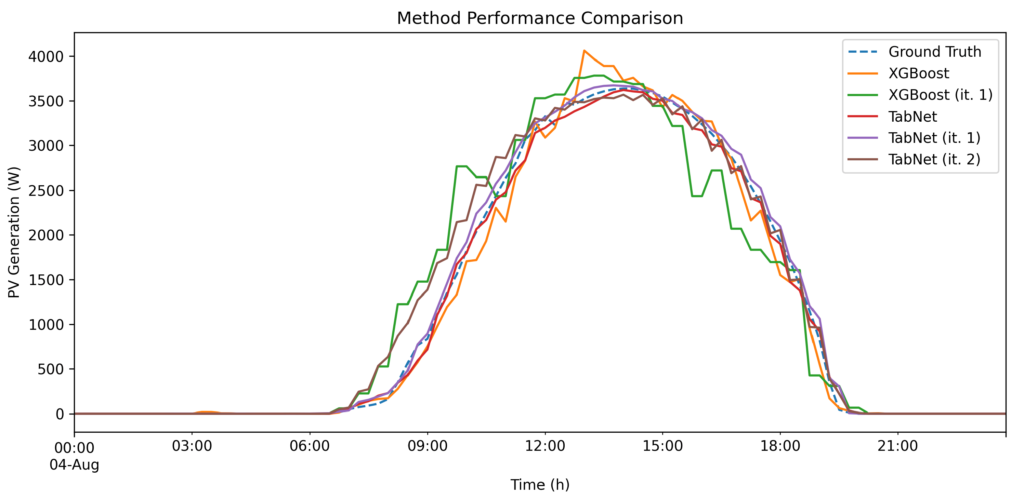
Importantly, the paper also introduces an XAI-based feature selection method that reduces the number of input variables while maintaining—or even improving—forecast accuracy. By lowering computational requirements and simplifying model design, this approach supports scalable implementation in decentralized energy systems.
This work aligns closely with U2Demo’s mission to empower peer-to-peer energy communities by integrating trustworthy AI tools that enhance decision-making. Transparent forecasting models like the one proposed in this study can help community members better manage energy production, consumption, storage, and trading, ultimately supporting more efficient, resilient, and user-driven energy systems.
Read the full article on our publications page.
Comments are closed.